If you’re evaluating warehouse management software for your Shopify store or 3PL relationship, two names come up frequently: Zoho Inventory and Extensiv (formerly 3PL Central). They’re both legitimate platforms, but they serve very different business models. Choosing the wrong one is an expensive mistake.
This comparison breaks down exactly where each platform fits, what they do well, where they fall short, and which is right for your specific situation.
Platform Overview
Zoho Inventory
Zoho Inventory is an order and inventory management system designed for businesses that manage their own stock. It handles multi-channel selling (Shopify, Amazon, eBay, and more), purchase orders, vendor management, packing and shipping, and basic warehouse organization. It’s included in Zoho One or available as a standalone subscription.
The key context: Zoho Inventory is designed for brand owners who manage their own warehouse or fulfillment. It’s an IMS (inventory management system), not a WMS (warehouse management system). The distinction matters.
Extensiv (formerly 3PL Central)
Extensiv is a warehouse management and order management platform built specifically for 3PL operations. It powers the warehouse floor — bin locations, receiving workflows, pick-pack-ship, carrier label printing, cycle counting, and client billing. It’s what your 3PL runs their warehouse on, and the integration your brand connects to when you outsource fulfillment to a 3PL.
Extensiv also offers Extensiv Order Manager (for brand owners managing orders across multiple fulfillment partners) — but the core Extensiv product is a 3PL warehouse platform.
Who Each Platform Is Built For
This is the most important distinction in this comparison:
- Zoho Inventory is for brand owners who self-fulfill. If you manage your own warehouse — picking, packing, and shipping orders yourself — Zoho Inventory gives you multi-channel order routing, purchase order management, vendor management, and enough warehouse organization for a brand that hasn’t outsourced fulfillment.
- Extensiv is for 3PLs and brands using 3PLs. If your fulfillment is handled by a third-party logistics provider, Extensiv is the platform the 3PL runs their warehouse on. Your brand connects to Extensiv via Shopify integration to pass orders to the 3PL and receive tracking numbers back.
You are not choosing between these two platforms as a brand owner — you’re choosing which one fits your fulfillment model. If you self-fulfill: Zoho Inventory. If you use a 3PL that runs Extensiv: your brand connects to Extensiv. If you’re evaluating 3PLs: ask which WMS they use and whether Extensiv integration is supported.
Feature Comparison
Multi-Channel Order Management
Zoho Inventory aggregates orders from Shopify, Amazon, eBay, Etsy, and other channels. Orders from all channels appear in one dashboard, can be routed to different fulfillment locations, and sync inventory levels back to each storefront.
Extensiv handles order management for 3PLs: orders come in from brand clients’ storefronts, are organized for pick-pack-ship, and tracking numbers are sent back. For a brand using a 3PL on Extensiv, the order routing happens through the 3PL’s operations, not through your own system.
Warehouse Management
Zoho Inventory has basic warehouse organization: bin/rack location tracking, packing slips, shipping label generation. Sufficient for a brand doing 50–300 orders/day out of a small warehouse. Not sufficient for complex warehouse operations with multiple zones, optimized pick paths, or high-volume pick-pack.
Extensiv’s warehouse management is enterprise-grade: bin-level tracking, optimized pick paths, cycle counting, receiving workflows, lot and serial number tracking, 3PL billing management, and a mobile WMS app for warehouse staff. This is what you need for a proper 3PL operation handling hundreds to thousands of orders per day.
Purchase Orders and Vendor Management
Zoho Inventory has strong PO management: create POs, track vendor lead times, receive inventory against POs, and update stock levels automatically on receipt. Extensiv handles receiving in a 3PL context but doesn’t manage the brand’s vendor relationships — that’s the brand’s own system’s job.
Reporting
Zoho Inventory reporting covers inventory turnover, low stock alerts, SKU performance, and order volume. Combined with Zoho Analytics, it becomes a full operations reporting suite. Extensiv reporting is 3PL-focused: client billing, receiving accuracy, pick accuracy, carrier performance.
Shopify Integration
Zoho Inventory + Shopify
Native Shopify integration: orders sync from Shopify to Zoho Inventory automatically. Fulfillment updates from Zoho Inventory sync back to Shopify with tracking numbers. Inventory levels in Zoho Inventory update Shopify stock counts in real time. This is a well-established integration that works cleanly for self-fulfillment brands.
Extensiv + Shopify
Extensiv has a native Shopify integration used by brands connecting their store to a 3PL that runs Extensiv. Orders from Shopify flow to the 3PL’s Extensiv WMS. Tracking numbers flow back to Shopify. This is the integration we configure during 3PL onboarding projects — it requires SKU mapping, carrier configuration, order routing rules, and UAT testing before going live.
Pricing
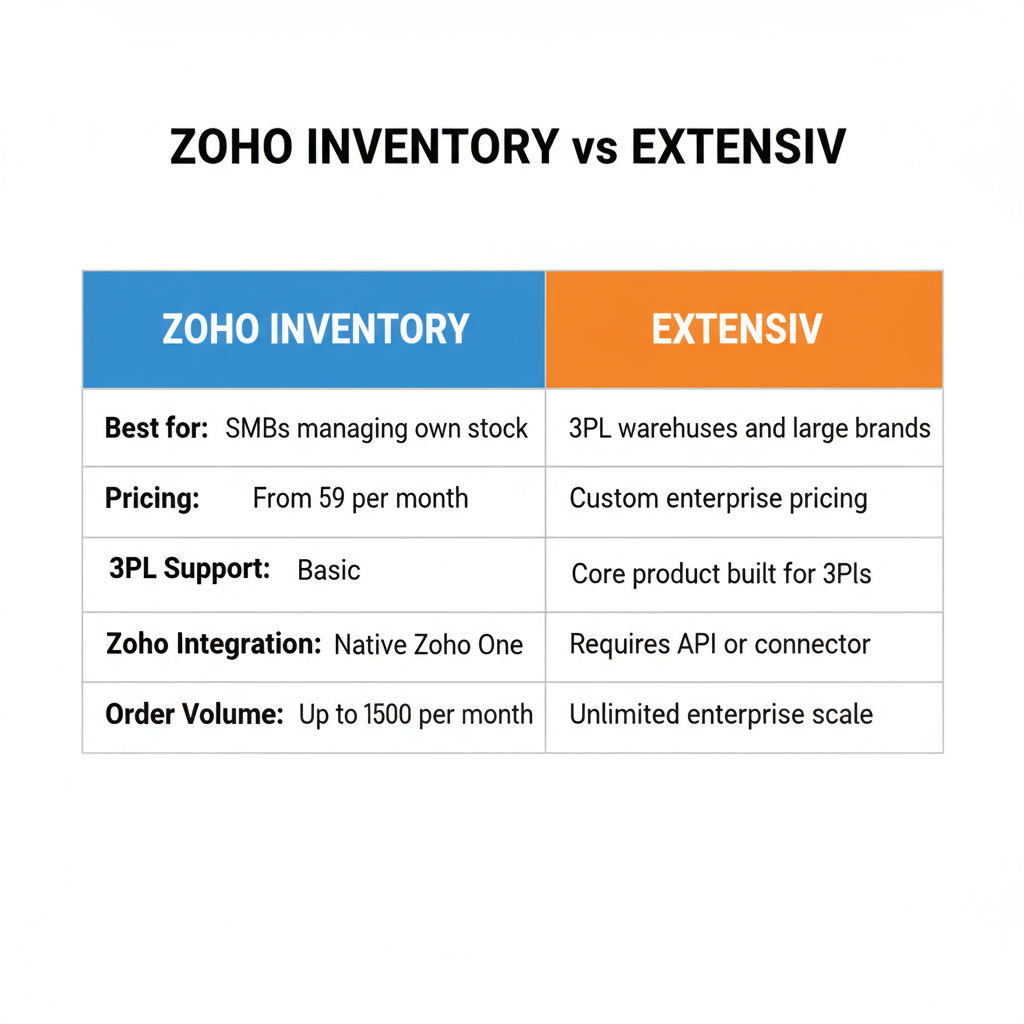
Zoho Inventory: Included in Zoho One (~$37 USD/user/month). Standalone plans start at approximately $29 USD/month for 50 orders/month, scaling with order volume and users. Free plan available for very small operations.
Extensiv: Enterprise pricing — typically quoted per client account for 3PLs, with setup fees and monthly per-order or per-unit charges. Pricing is not publicly listed and varies significantly based on the 3PL’s volume and configuration. If you’re a brand connecting to a 3PL that uses Extensiv, you typically don’t pay Extensiv directly — your 3PL pays for the platform and charges you fulfillment fees that cover their software costs.
The 3PL Context
The most common scenario for growing Shopify brands is this: you start self-fulfilling and manage inventory in Zoho Inventory (or Shopify’s native inventory). As volume grows, you move to a 3PL. The 3PL runs Extensiv. You now connect Shopify to Extensiv via the 3PL’s integration.
At this point, Zoho Inventory may become partially redundant for day-to-day inventory management — the 3PL’s Extensiv becomes the inventory source of truth for what’s physically at the warehouse. You may still use Zoho Inventory for purchase order management (ordering from vendors), for managing stock across multiple locations (e.g., some stock at the 3PL, some at your own location), or as a reporting layer that aggregates inventory data from multiple sources.
The key decision: when you move to a 3PL, clarify which system is master for inventory. If the 3PL’s Extensiv is master, configure Zoho Inventory (or Shopify) to receive inventory updates from Extensiv, not the other way around.
Verdict
- Self-fulfilling Shopify brand: Use Zoho Inventory. It handles multi-channel orders, vendor management, and basic warehouse organization efficiently. If you’re on Zoho One, it’s included at no extra cost.
- Brand using a 3PL on Extensiv: Connect Shopify to your 3PL’s Extensiv integration. You don’t need Zoho Inventory for physical inventory management. Keep Zoho Inventory (or a simple IMS) for PO management and multi-location tracking if you have stock in multiple places.
- Brand evaluating 3PLs: Ask every 3PL which WMS they use. Extensiv-based 3PLs are well-supported with Shopify integrations. Confirm Shopify integration capability before signing any 3PL contract.
Need help setting up your Shopify–3PL integration or Zoho Inventory configuration? Learn about our 3PL Integration service or book a free discovery call.
Frequently Asked Questions
Can I use both Zoho Inventory and Extensiv together?
Yes. A common setup for brands with a 3PL: Extensiv manages physical warehouse inventory at the 3PL, and Zoho Inventory handles purchase orders, vendor management, and multi-location stock tracking. Inventory level updates flow from Extensiv to Zoho Inventory (or directly to Shopify). The key is defining which system is master for each data type.
Is Zoho Inventory good enough for a growing Shopify brand?
Yes, for brands self-fulfilling up to a few hundred orders per day from a single or small number of locations. At high volume or with complex warehouse operations (multiple zones, optimized pick paths, 3PL billing), a dedicated WMS like Extensiv or ShipBob is more appropriate. Zoho Inventory is a strong IMS; it’s not a full enterprise WMS.
Does Extensiv work with Shopify?
Yes. Extensiv has a native Shopify integration that passes orders from Shopify to the 3PL’s WMS and sends tracking numbers back to Shopify. The integration requires SKU mapping, carrier configuration, and UAT testing before going live — typically managed during 3PL onboarding.
What is the difference between an IMS and a WMS?
An IMS (inventory management system) tracks what stock you have, where it is, and manages reordering. A WMS (warehouse management system) manages the physical operations of a warehouse: bin locations, receiving workflows, optimized pick paths, cycle counting, and carrier label printing. Zoho Inventory is an IMS; Extensiv is a WMS. Growing brands often need both as they scale.
How much does Extensiv cost?
Extensiv is enterprise software with pricing negotiated based on the 3PL’s volume and requirements. If you’re a brand using a 3PL that runs Extensiv, you typically don’t pay Extensiv directly — the 3PL’s fulfillment fees cover their platform costs. If you’re evaluating Extensiv directly (e.g., for in-house use or a 3PL operation), expect enterprise pricing quotes in the range of $1,000–$5,000+ USD/month depending on volume and features.
Keep reading
- AI Tools for Inventory Management: What’s Worth Using in 2026
- Extensiv (3PL Central) Review 2026: Best for Which Businesses?
- Inventory Financing for E-commerce: When to Use It and How to Qualify
- Shopify + Extensiv Integration: Complete Setup Guide (2026)
Need hands-on help? Explore our 3PL Integration →
