Peak season — Black Friday through Christmas for most DTC brands — is when six months of operational shortcuts come due at once. The inventory system that barely worked in October fails completely in November. The 3PL that handled 400 orders per day in September gets overwhelmed at 1,200 per day in the week after Black Friday. The customer service queue that was manageable with one agent hits three times its usual volume on the Monday after BFCM.
Peak season fulfillment is not a different problem than everyday fulfillment. It is the same problems, compressed and amplified. Brands that handle it well are the ones who did the preparation work in September and October, not the ones scrambling in November. This guide covers the preparation timeline, the key decisions, and the operational details that separate a peak season that builds your brand from one that damages it.
The 90-Day Peak Season Preparation Timeline
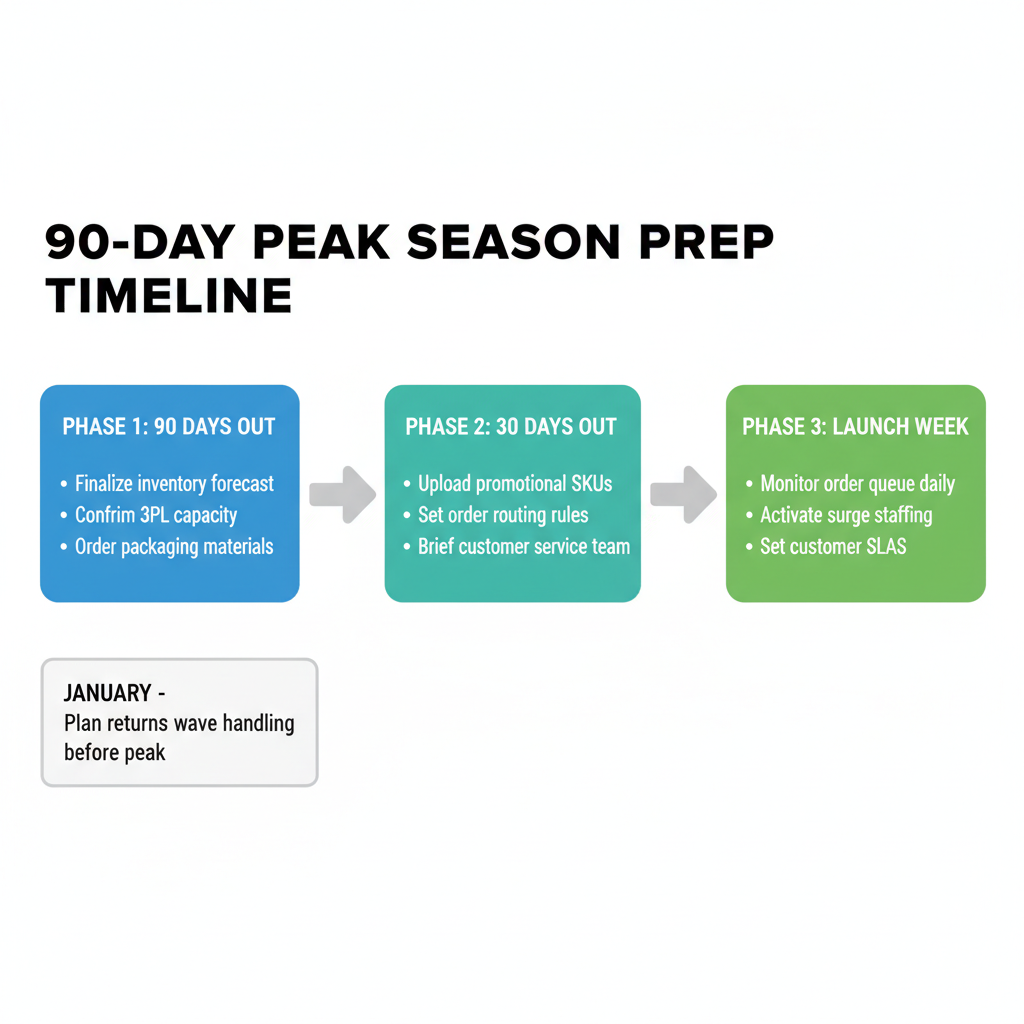
Ninety days before your peak period starts, run through this preparation calendar:
- Day 90 (early September for Q4): Finalize inventory forecast. Review last year’s sell-through by SKU during peak weeks. Apply this year’s growth rate. Add a 15 to 20 percent buffer on your top 20 SKUs. Place purchase orders with suppliers — peak inventory needs to be at your 3PL by day 21, not arriving during the peak itself.
- Day 75: Contact your 3PL with your volume forecast. Provide week-by-week units-per-day projections. Discuss any special peak services: gift wrapping, promotional inserts, kitting. Confirm their receiving capacity — you need your peak inventory on their dock with enough time for receiving and put-away before BFCM.
- Day 60: Review all your Shopify integrations under simulated peak load. Does your order routing still work correctly at 500 orders per day? Does your inventory sync keep up? Run test orders through the full fulfillment path and verify tracking numbers are posting back correctly.
- Day 45: Build your customer communication calendar. Create shipping deadline copy for homepage banner, checkout page, order confirmations, and email campaigns. Identify your cutoff dates for each shipping speed to each major Canadian and US region. Build your FAQ update for the holiday shipping page.
- Day 30: Onboard any seasonal CS staff or train your existing team on peak-specific macros. Set up Gorgias automation rules for the surge of expected WISMO (Where Is My Order) tickets. Brief your 3PL on any peak-specific packing requirements.
- Day 14: Run a full peak readiness review with your 3PL. Confirm inventory is received and putaway, not still in receiving queue. Verify carrier account setups. Confirm escalation contacts on both sides. Set up daily check-in calls for the peak weeks.
Inventory Positioning for Peak
The most common peak season failure is inventory arriving late. Your peak inventory needs to be received, counted, put away, and ready to pick at your 3PL at least three weeks before your peak period starts. Inventory that arrives during the peak competes with outbound orders for dock time and receiving staff, gets delayed in the receiving queue, and creates the exact stockout scenario you were trying to prevent.
Build your inventory forecast from the bottom up. Start with each SKU’s average weekly sales rate over the past 90 days. Apply your expected peak multiplier based on last year’s data — most DTC brands see a 3x to 5x spike in their peak weeks versus a normal week. Add your growth rate. Then add a buffer: 15 to 20 percent on your top 20 SKUs, 10 percent on the rest.
Set a Shopify low stock threshold notification for peak inventory. If a top SKU drops below 50 units in mid-November, you need to know immediately — not at end-of-day reporting. Gorgias automation rules can trigger internal alerts based on Shopify inventory levels if you configure them correctly.
3PL Communication and Capacity Planning
Your 3PL is running peak season for dozens or hundreds of clients simultaneously. They are not going to proactively ask you what your volume forecast is. The brands that get prioritized during peak — that get their orders processed on time even when the 3PL is processing 400 percent of normal volume — are the ones that had the capacity conversation 60 to 90 days out and gave their operations team real numbers to plan against.
Your peak season capacity briefing to the 3PL should include: week-by-week units-per-day projections for the eight weeks of peak season, your inbound receiving schedule (which POs arrive when, how many SKUs, what pallet count), any special handling requirements for peak orders (gift notes, branded tissue paper, promotional inserts), your priority SKU list (if they are overwhelmed, which orders ship first), and the name and cell number of your ops contact who will be available on BFCM weekend.
Get written confirmation of the 3PL’s SLA for peak processing times. A 3PL that normally ships orders same-day may expand to a 24 or 48-hour processing window during peak. You need to know this before your customers need to know it so you can set delivery expectations accurately at checkout.
Order Routing Rules for Peak Volume
Review your Shopify order routing rules before peak season. Rules that work fine at 200 orders per day may create problems at 800. Common issues to audit:
- Does your routing handle gift orders differently? Gift orders often have different packing requirements that slow processing if the 3PL is not set up to handle them at scale.
- Are pre-orders routed to a hold location or immediately to the 3PL pick queue? Pre-orders pushed to the 3PL before stock arrives clog the queue with unfulfillable tasks.
- Do B2B and wholesale orders route to a different fulfillment queue than DTC orders? During peak, your 3PL may have limited capacity for pallet-level wholesale fulfillment if the DTC pick line is at maximum throughput.
- What happens to an order when a SKU is out of stock? Does it automatically cancel, hold, or route to a manual review queue? Each choice has customer communication implications you need to decide before peak, not in the moment.
Customer Communication Strategy
Proactive communication during peak season is the single most cost-effective investment in reducing CS ticket volume. Every customer who knows their order is on its way, knows what day to expect it, and knows what to do if something goes wrong is a customer who does not need to open a ticket.
The peak communication toolkit: a homepage banner and checkout page notice showing your holiday shipping cutoff dates for each delivery speed, an order confirmation email with explicit delivery estimate (not just “5 to 7 business days” but “estimated arrival December 18 to 20”), a shipping confirmation email with live tracking link and a proactive note that peak season can add 1 to 2 business days versus normal delivery times, and a post-peak FAQ update for your help center addressing common questions before they become tickets.
Set your published cutoff dates conservatively. If you are confident orders placed by December 18 will arrive before December 24, publish December 16 as your guaranteed cutoff. The buffer covers carrier delays. The cost of an undelivered Christmas present is far higher than the cost of a slightly conservative cutoff date.
Preparing for the January Returns Wave
January returns are predictable — plan for them in December, not when they arrive. Typical ecommerce brands see 15 to 25 percent of their November-December sales volume return in January. Your returns infrastructure needs to handle this without backing up your 3PL receiving dock.
Communicate your holiday return policy prominently during the purchase: a 60 or 90-day return window for holiday purchases reduces purchase anxiety, increases conversion, and spreads returns over a longer period rather than creating a January spike. Update your Loop Returns portal with a gift return flow before BFCM so recipients can initiate returns without the original purchaser needing to be involved. Coordinate with your 3PL on returns processing capacity for January — they need to plan staffing for this the same way they plan for outbound volume in November.
The Post-Peak Operations Review
Within two weeks of the peak season ending, run a structured review while the details are fresh. What broke? What held? Where were the closest calls? Document the specific dates and volumes at which each part of the operation showed stress. This becomes your planning input for next year’s preparation timeline.
Specific questions to review: What was the ticket-to-order ratio during peak weeks versus normal weeks? What SKUs nearly stocked out and what was the lead time on reorder? What was the 3PL’s actual processing time SLA compliance during peak? What did customers complain about most? What would have happened if volume was 20 percent higher — what would have broken first?
ScaleOps helps Canadian product brands build peak-ready fulfillment operations. If last peak season was your stress test, book a free discovery call before the next one arrives.
Frequently Asked Questions
How early should you start preparing for peak season fulfillment?
Start 90 days before your peak. For Q4, that is early September. The 90-day window covers supplier POs (90 days), 3PL capacity conversations (60 days), integration testing (45 days), customer communication prep (30 days), and a final readiness review (14 days out).
How do you prevent stockouts during Black Friday and Cyber Monday?
Build your forecast from last year’s sell-through data plus your growth rate, add a 15 to 20 percent buffer on top 10 SKUs, have all peak inventory received and put away at your 3PL three weeks before BFCM, and set low-stock alerts so you know immediately when a top SKU drops below threshold.
What should you communicate to customers about holiday shipping cutoffs?
Publish shipping deadline calendars on your homepage, checkout page, and in order confirmation emails. Set conservative cutoffs to build in carrier delay buffer. A missed Christmas delivery is far more expensive than an early cutoff date.
How do you handle a surge in returns after the holiday season?
Prepare your returns infrastructure in December: set up a gift returns flow in your returns portal, communicate a 60 to 90-day return window to spread the returns over time, and coordinate with your 3PL on January receiving capacity. Plan for 15 to 25 percent of November-December volume returning in January.
What is a peak season capacity conversation with a 3PL?
A formal pre-season discussion covering your week-by-week volume forecast, inbound receiving schedule, special handling requirements, and your ops contact for the peak period. Most 3PLs need this 60 to 90 days before peak to plan staffing and dock capacity. Skip it and risk being deprioritized during your busiest weeks.
Keep reading
- How to Write an E-commerce Fulfillment Coordinator Job Description
- Shopify Dropshipping: How to Build a Profitable Business in 2026
- Shopify + Extensiv Integration: Complete Setup Guide (2026)
- How to Choose a Shipping Carrier for Your Shopify Store (2026)
Need hands-on help? Explore our 3PL Integration →
