Most Shopify brands start DTC and add wholesale as an afterthought. The problem is that wholesale and direct-to-consumer have fundamentally different operational requirements: different pricing, different order sizes, different payment terms, different fulfillment workflows, and different customer service expectations. When you try to manage both from the same backend without intentional design, the cracks show fast.
This guide covers how to build a Shopify operation that handles wholesale and DTC simultaneously without creating two sets of processes, two teams, or two systems. The goal is one coherent backend that serves both channels cleanly.
How DTC and B2B Operations Actually Differ
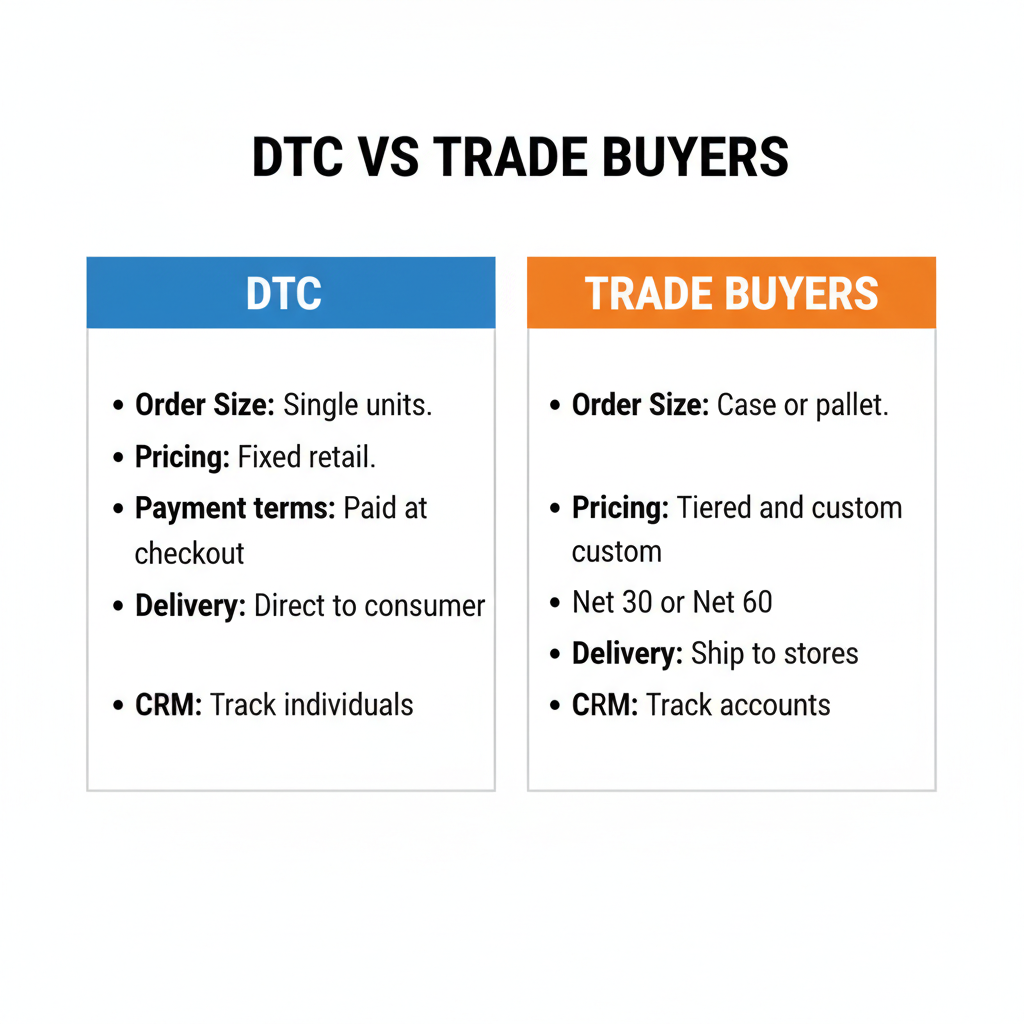
Before designing your operations, understand what is genuinely different between the two channels. Not all differences require different systems — some just require different configuration.
Order size: DTC orders are typically 1 to 5 units per order. Wholesale orders are case packs, half-pallets, or full pallets. Fulfillment workflows are different: DTC orders pick individual units; wholesale orders may require pallet assembly, freight coordination, and GS1 barcode compliance for retail buyers.
Pricing: DTC operates at MSRP. Wholesale operates at a discount to MSRP — typically 40 to 60 percent. Within wholesale, different accounts often get different tiers: your national distributor gets better pricing than a small independent retailer. Managing multiple price lists for multiple accounts is something Shopify handles differently at different plan levels.
Payment terms: DTC customers pay immediately at checkout. Wholesale accounts typically operate on net terms (Net 30, Net 60) and pay via invoice rather than card. This means revenue is recognized but cash is delayed, and you need AR tracking outside of Shopify’s native checkout flow.
Relationship model: DTC customers are anonymous buyers acquired through marketing. Wholesale accounts are named businesses with negotiated terms, dedicated contacts, and ongoing relationship management. They belong in a CRM, not just in Shopify customer records.
Shopify Plus B2B: What You Get
Shopify Plus introduced native B2B features that meaningfully reduce the operational overhead of running wholesale and DTC together. The core features:
- Company accounts: A company record in Shopify that houses multiple buyers (contacts), their roles, and their ordering permissions. Your main buyer, an assistant buyer, and an accounts payable contact can all log in under the same company account with different access levels.
- Price lists per company: Assign a specific price list to each company account. Company A sees 50 percent wholesale pricing; Company B sees 45 percent as a VIP account. Price lists apply automatically when that account logs in — no coupon codes, no discount overrides.
- Net payment terms: Set Net 15, Net 30, or Net 60 terms per company. Orders are placed without immediate payment; Shopify generates an invoice with a due date. Payment is collected via your AR process outside of checkout.
- Purchase order numbers: B2B buyers can enter a PO number at checkout, which appears on the order and any invoices — a basic requirement for most retail and institutional buyers.
- Separate B2B storefront: A dedicated login-only portal for wholesale buyers, separate from your DTC storefront. Same product catalog, different pricing, different checkout flow.
Shopify Plus starts at $2,300 USD per month. For brands doing significant wholesale volume — typically $500K or more annually through Shopify — the operational savings from native B2B features often justify the plan upgrade. For brands with smaller wholesale channels, standard Shopify with workarounds may be more cost-effective.
Wholesale on Standard Shopify: The Workarounds
If you are on standard Shopify and not ready for Plus, there are two main approaches to running wholesale:
Draft Order Workflow
Your sales rep or ops team creates a draft order in Shopify admin for each wholesale purchase. They manually apply wholesale pricing (using a discount or a price override), add the PO number as a note, and send the invoice to the buyer. The buyer approves and pays via the invoice link or bank transfer. This works for low wholesale order volume (under 20 orders per month) but creates significant manual overhead at higher volumes.
Wholesale App + Customer Tags
Apps like Wholesale Gorilla ($39 to $79 per month) add a wholesale portal on top of your existing Shopify store. Approved wholesale customers are tagged in Shopify; when they log in, they see wholesale-specific pricing instead of MSRP. Minimum order quantities, case pack requirements, and net terms are configurable within the app. This is significantly more scalable than the draft order workflow and appropriate for brands doing 20 to 200 wholesale orders per month.
Managing Net Terms and Accounts Receivable
Net terms create an AR management problem that Shopify alone cannot solve. When a wholesale account places a Net 30 order, you need to track: when the invoice was issued, when payment is due, whether payment has been received, and what to do when payment is late.
For brands with fewer than 20 wholesale accounts, tracking AR in a spreadsheet or in Zoho CRM is workable. For brands with 50-plus accounts and significant wholesale volume, a dedicated AR process is needed: Zoho Books or QuickBooks handles invoice issuance, payment matching, overdue reminders, and statements. Connect your accounting system to Shopify so wholesale orders create invoices automatically rather than requiring manual entry.
Common AR mistakes: issuing invoices without PO numbers (buyers will dispute payment without their PO reference), not setting credit limits per account (a new wholesale account ordering $50K on Net 30 before they have established payment history is a cash flow risk), and not having a clear late payment policy communicated upfront in your wholesale terms.
Wholesale Fulfillment Workflow
Wholesale fulfillment has different requirements from DTC. Large retail buyers often have specific routing guide requirements: specific carrier accounts, specific label formats, specific carton marking, and in some cases EDI (Electronic Data Interchange) compliance for purchase order transmission.
Before you accept your first large retail purchase order (Costco, Indigo, a regional grocery chain), get their routing guide and read it cover to cover. Non-compliance with routing requirements results in chargeback deductions from your invoice — sometimes 5 to 15 percent of the order value.
For smaller wholesale accounts (independent retailers, online wholesalers), fulfillment is simpler: pick the case packs, generate a commercial invoice and packing slip, and ship on your freight account or the buyer’s account. Many small brands fulfill small wholesale orders from the same 3PL that handles DTC — the difference is the pick ticket specifies case quantities rather than individual units.
How Wholesale Affects Your DTC Inventory
Wholesale orders placed through Shopify deduct from the same inventory pool as DTC orders. This creates a real risk: a large wholesale PO placed on a Monday can deplete the inventory your DTC channel needs for the rest of the week. Without inventory reservation, your DTC customers hit the out-of-stock page because a retailer bought 500 units this morning.
Solutions range in complexity. The simplest: hold separate inventory at your 3PL for wholesale (dedicated bins or a separate SKU suffix) and fulfill wholesale from that pool, DTC from the DTC pool. More sophisticated: use a dedicated inventory management system like Cin7 Core that supports channel-based inventory reservation. Most sophisticated: configure Shopify multi-location to put wholesale inventory in a different location than DTC inventory, and route wholesale orders to the wholesale location.
Wholesale Account Management Belongs in a CRM
Wholesale accounts are relationships, not transactions. Your top 10 wholesale accounts likely represent 40 to 60 percent of your wholesale revenue. Managing those relationships from Shopify customer records alone means you lose track of conversations, commitments, seasonal buying calendars, and performance trends.
A CRM like Zoho CRM gives each wholesale account a proper Account record with: contact hierarchy (buyer, AP contact, store manager), full order history synced from Shopify, notes from rep calls, seasonal buying forecasts, and automated follow-ups when an account has not reordered in 60 days. The integration between Shopify and Zoho CRM means the data flows automatically — no manual entry.
ScaleOps sets up Shopify B2B operations for Canadian product brands, including Zoho CRM integration for wholesale account management. If your wholesale operation is running on spreadsheets and manual draft orders, book a discovery call.
Frequently Asked Questions
Can you manage wholesale and DTC from one Shopify store?
Yes. Shopify Plus includes native B2B features: company accounts, custom price lists, net payment terms, and a wholesale portal. On standard Shopify, brands use draft order workflows or apps like Wholesale Gorilla. The inventory and product catalog are shared; pricing and ordering experience are separated per channel.
What is Shopify B2B and what plan does it require?
Shopify B2B is a native wholesale feature set including company accounts, custom price lists, net terms, PO numbers, and a B2B storefront. It requires Shopify Plus at $2,300 USD per month. For brands under $500K in wholesale revenue, standard Shopify with apps is usually more cost-effective.
How do you handle net terms on Shopify wholesale orders?
On Shopify Plus, net terms are set per company account through native B2B. On standard Shopify, net terms are handled manually through draft orders and external invoicing via Zoho Books or QuickBooks. Payment is collected outside checkout via bank transfer or payment link.
What apps help manage wholesale on Shopify without Shopify Plus?
Wholesale Gorilla ($39 to $79 per month) adds a wholesale portal with custom pricing tiers, minimum order quantities, and net terms. For smaller volumes, a draft order workflow with customer tags and price lists often works without additional apps.
How do wholesale orders affect Shopify inventory?
Wholesale orders deduct from the same inventory pool as DTC orders unless you deliberately separate them using multi-location settings, channel-specific SKUs, or a dedicated inventory management system. Without separation, a large wholesale PO can deplete DTC available inventory unexpectedly.
Keep reading
- How to Build a Shopify B2B Wholesale Channel
- How to Set Up B2B and Wholesale on Shopify: A Practical Guide
- Shopify Wholesale & B2B Pricing: Apps, Strategies, and Setup
- How to Reduce Shopify Cart Abandonment Through Better Operations
Need hands-on help? Explore our Shopify Operations →
