At some point between $500K and $2M in revenue, every Shopify brand hits the same wall. The store is working. Orders are coming in. But operations feel like duct tape — you are manually reconciling inventory in spreadsheets, your support team is copy-pasting tracking numbers, and returns are handled through a shared inbox. The problem is not Shopify. The problem is that you never built an operations stack around it.
This guide breaks down exactly what apps and tools belong in a Shopify operations stack at each growth stage, what they cost, and in what order to add them. If you are at $1M revenue and scaling, this is the sequencing guide you need.
What Is a Shopify Operations Stack?
A Shopify operations stack is the collection of apps, integrations, and back-office tools that sit around your Shopify store to handle everything Shopify core does not: returns processing, inventory management across locations, customer support workflows, attribution, fulfillment coordination, and financial reconciliation.
Shopify is a commerce platform, not an operations platform. It handles transactions, product listings, and basic order routing well. But it was not designed to be your WMS, your ERP, your support desk, or your post-purchase experience tool. That is what the stack is for.
The Five Layers of a Shopify Operations Stack
\n\n\n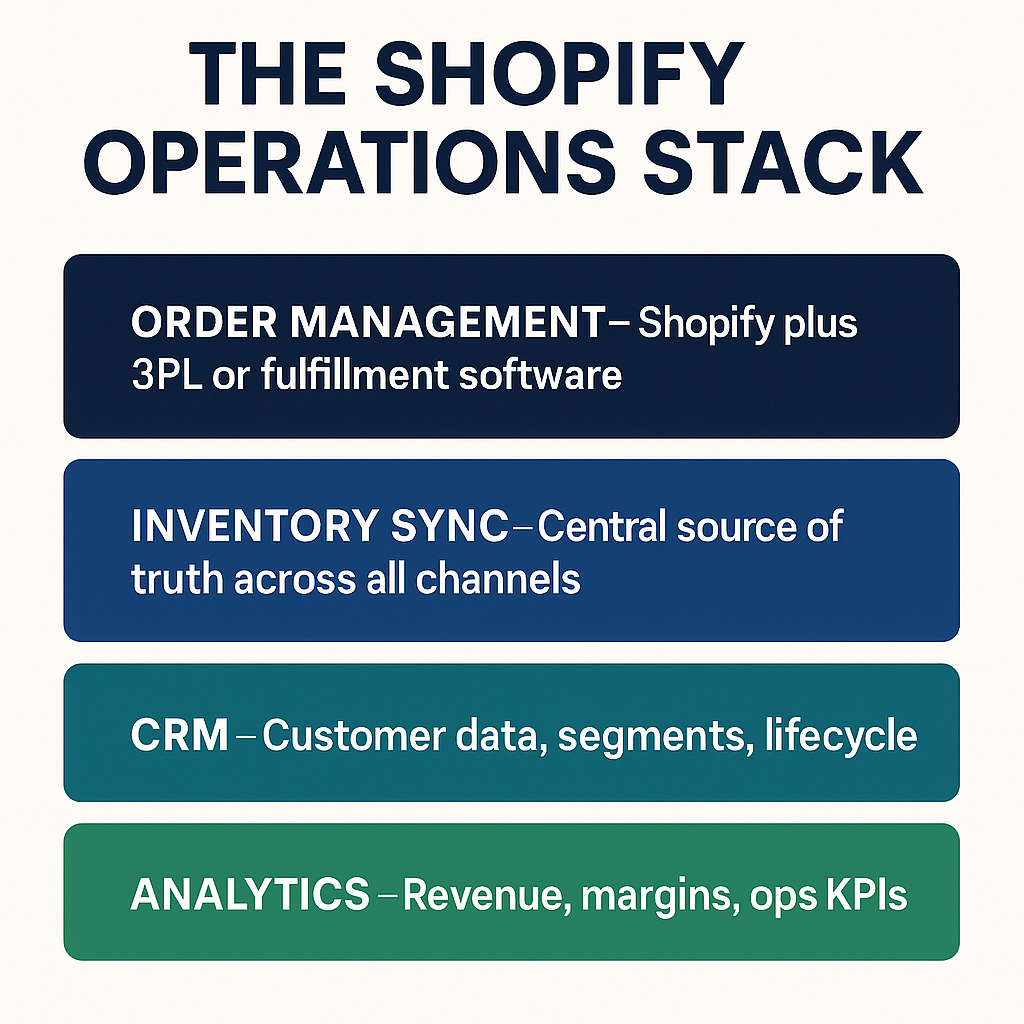
A complete Shopify ops stack covers five functional layers. Not every brand needs all five at launch, but understanding the layers helps you sequence your tooling correctly.
Layer 1: Customer Support
Your support platform sits on top of Shopify and gives agents full order context without switching tabs. The two dominant tools in this layer are Gorgias and Reamaze.
Gorgias is the category leader for Shopify brands. It pulls order data, subscription status, LTV, and previous tickets into a single view. Pricing runs from $10/month for starter plans up to $900/month for brands handling thousands of tickets. At $1M to $3M revenue, most brands fit in the $60 to $300/month range. Gorgias integrates natively with Loop Returns, Klaviyo, and ShipBob, which makes it the connective tissue for post-purchase workflows.
Reamaze is a lower-cost alternative ($29 to $169/month) that works well for brands with simpler support volumes. It lacks some of Gorgias’s Shopify-native automation depth but covers the basics effectively.
Layer 2: Returns Management
Returns are a margin problem disguised as a logistics problem. The NRF estimated that US retail returns totalled $890 billion in 2024. For e-commerce brands, return rates typically run 20 to 30 percent. Manual returns processing at that volume is not sustainable.
Loop Returns is the standard for Shopify DTC brands. It automates return eligibility checks, generates prepaid labels, and drives exchanges over refunds — protecting revenue on returns that would otherwise be lost. Pricing runs from $155/month (Starter) to $340/month (Essential) for most growing brands. Loop integrates with Gorgias, ShipBob, and most 3PLs, which is why it appears in nearly every mature Shopify stack.
Returnly (now owned by Affirm) is an alternative with stronger instant credit features but less Shopify-native depth than Loop at the mid-market level.
Layer 3: Inventory and Order Management
This is the layer most brands under-invest in, and it is where operations break first. Shopify native inventory handles single-location, simple-SKU brands adequately. Add a 3PL, a wholesale channel, or bundles, and you need a dedicated system.
An important note: Shopify retired its Stocky inventory app on August 31, 2026. Stocky was the only free dedicated tool Shopify offered for purchase order management. Brands still relying on it needed to migrate before that date.
Cin7 Core (formerly DEAR Inventory) is the most common upgrade path for $1M to $10M Shopify brands. It handles multi-location inventory, purchase orders, supplier management, and B2B order processing. Pricing runs from $349/month (Standard) to $999/month (Advanced). At $3M to $5M revenue with a 3PL relationship, Cin7 Core typically pays for itself in reduced stockouts and overstock costs within the first year.
Brightpearl sits above Cin7 Core in complexity and cost. It is better suited for brands combining DTC and wholesale at $10M+ revenue. Pricing is custom but typically starts around $375/month.
Inventory Planner is purpose-built for demand forecasting rather than transaction management. At $99 to $499/month, it layers on top of Shopify or Cin7 to help buyers make smarter replenishment decisions. It integrates with most major Shopify inventory tools.
Layer 4: Analytics and Attribution
Shopify Analytics covers basic revenue and conversion reporting well. What it does not cover is multi-touch attribution, contribution margin by channel, and cohort LTV — the numbers that actually drive scaling decisions.
Triple Whale is the most widely adopted attribution platform for Shopify DTC brands. It pulls blended ROAS, contribution margin, and attributed revenue from Meta, Google, and TikTok into a single dashboard. Pricing runs from $149/month (Summary) to $219/month (Growth) for most brands. Triple Whale launched its Stateful attribution model in 2024 to address iOS 14 signal loss, which meaningfully improved accuracy over last-click models.
Northbeam is the enterprise alternative, typically adopted by brands spending $100K+ per month in paid media. It offers more granular multi-touch modeling but comes with significantly higher cost and setup complexity.
Layer 5: Email, SMS, and Retention
Klaviyo is the default for Shopify retention marketing. Its Shopify integration is deep enough that flows like post-purchase sequences, winback campaigns, and abandoned cart recover revenue that would otherwise be lost. Pricing scales with list size — $150 to $700/month is typical for $1M to $5M brands. Klaviyo connects to Loop Returns and Gorgias, which enables automated post-return flows and support-triggered win-back sequences.
How to Sequence Your Stack Build
Adding every layer at once is expensive and operationally disruptive. The right sequencing depends on your current revenue, pain points, and growth trajectory. Here is a practical six-phase guide.
- Phase 1 (Pre-$500K): Shopify native inventory, Klaviyo (free tier), basic support via email. Keep the stack minimal — complexity before scale creates drag, not efficiency.
- Phase 2 ($500K–$1M): Add Gorgias (Starter) for support consolidation. Add Loop Returns if your return rate exceeds 15 percent. Connect Klaviyo post-purchase flows to order data.
- Phase 3 ($1M–$2M): Add Triple Whale for attribution clarity as ad spend increases. Upgrade Gorgias plan as ticket volume grows. Begin evaluating inventory management if SKU count exceeds 150 or 3PL conversations are starting.
- Phase 4 ($2M–$5M): Add Cin7 Core when inventory complexity requires it (multi-location, 3PL integration, purchase orders). Connect Cin7 to Shopify and your 3PL via native or middleware integration. Consider Inventory Planner for demand forecasting.
- Phase 5 ($5M–$10M): Evaluate Brightpearl if wholesale channel is significant. Add Northbeam if paid media spend exceeds $100K/month. Consider WMS integration for internal warehouse if applicable.
- Phase 6 ($10M+): ERP evaluation (NetSuite, Acumatica). Middleware for complex integrations (Pipe17, SKULabs). Advanced 3PL integrations with EDI requirements for retail channels.
What Does This Stack Actually Cost?
Here is a realistic breakdown of monthly costs for two growth stages.
Lean Stack ($1M–$3M Revenue): $470–$1,160/month
- Gorgias Starter/Basic: $10–$60/month
- Loop Returns Starter: $155/month
- Triple Whale Summary: $149/month
- Klaviyo (mid list): $150–$400/month
- Shopify native inventory (no additional cost)
- Total: $464–$764/month
Mature Stack ($3M–$10M Revenue): $1,700–$2,400+/month
- Gorgias Pro: $300–$900/month
- Loop Returns Essential: $340/month
- Triple Whale Growth: $219/month
- Klaviyo (larger list): $400–$700/month
- Cin7 Core Standard: $349–$999/month
- Inventory Planner: $99–$299/month
- Total: $1,707–$3,457/month
These costs are significant but should be evaluated against the operational cost of not having them: support agents manually looking up order data, refunds on returns that could have been exchanges, ad spend misattributed to the wrong channels, and stockouts caused by poor inventory visibility.
Common Integration Mistakes to Avoid
Building a Shopify ops stack is not just about choosing the right tools — it is about connecting them correctly. These are the most common integration mistakes that undo the value of good tooling.
- Adding Cin7 before your 3PL is stable: If your 3PL relationship is new or the integration between Shopify and your 3PL is not clean, adding a layer of inventory software amplifies the mess. Fix the 3PL connection first.
- Not mapping Gorgias macros to Loop return statuses: Support agents get return status questions constantly. Without a Gorgias-Loop integration that surfaces return status in tickets, agents are still switching tabs — eliminating the efficiency gain.
- Treating Triple Whale as a replacement for channel-native reporting: Triple Whale attribution is directional, not exact. Use it for budget allocation decisions, not for replacing Meta Ads Manager or Google Analytics for ad-level optimization.
- Over-building in Phase 2: Adding Cin7 at $1M when you have 50 SKUs and a single warehouse is over-engineering. The tool will not save you money at that stage — it will add complexity and a monthly cost with no return.
- Forgetting the middleware layer: Shopify to Cin7 to 3PL to Klaviyo requires data to flow correctly between all four. Without middleware or carefully mapped native integrations, you get duplicate orders, delayed fulfillment updates, and incorrect inventory counts.
Where Shopify Native Features Hit Their Limit
Shopify has invested heavily in its native feature set over the past three years. Shopify Markets, native B2B, and expanded inventory APIs have closed some gaps. But there are still hard limits that third-party tools address better.
Purchase order management: With Stocky discontinued, Shopify has no strong native PO management tool. Brands managing supplier relationships and replenishment cycles need Cin7 Core, Inventory Planner, or a comparable solution.
Returns exchange incentives: Shopify Returns handles basic return processing, but it does not offer exchange incentives or instant credit that Loop Returns provides. For brands where exchange rate on returns is a key profitability lever, Loop is materially better.
Multi-touch attribution: Shopify Analytics is last-click by default. In a multi-channel paid media environment post-iOS 14, last-click attribution systematically overstates Meta performance and understates email-assisted conversions. Triple Whale or Northbeam correct for this.
Support ticket context: Shopify Inbox handles basic chat but does not consolidate email, social DMs, SMS, and phone into a unified agent view with full order history. Gorgias does.
Notes for Canadian Shopify Brands
Most of the tools in this stack are US-headquartered but work well for Canadian brands. A few considerations specific to Canadian operations:
- Currency: Most SaaS tools price in USD. At current exchange rates, the mature stack above runs approximately $2,300 to $4,700 CAD/month — factor this into margin planning.
- 3PL integrations: Canadian 3PLs (Purolator, Canpar, Canada Post partnerships) have varying Shopify integration quality. Confirm your 3PL supports direct Shopify or Cin7 integration before committing.
- Returns carrier options: Loop Returns supports Canada Post and Purolator return labels. Verify carrier availability in your region before assuming prepaid return label generation will work out of the box.
- SR&ED eligibility: If you are building custom integrations between these tools, work done by Canadian developers may qualify for SR&ED tax credits. Document integration development costs accordingly.
When to Get Outside Help Building Your Stack
Most brands can configure the lean stack (Gorgias, Loop, Klaviyo, Triple Whale) themselves using documentation and vendor onboarding. The mature stack is a different story. Cin7 Core implementation with a 3PL, custom Shopify flows, and Gorgias automation requires someone who has done it before.
Signs you need outside help: the integration between two tools has been broken for more than two weeks, your inventory counts in Shopify consistently diverge from your 3PL WMS, or you are paying for three tools that should be talking to each other but are not.
ScaleOps Consulting specializes in Shopify operations infrastructure for Canadian product brands. If your stack is not working the way it should, book a free discovery call and we will tell you what needs to change.
Frequently Asked Questions
What apps does every Shopify brand need at $1M revenue?
At $1M revenue, the essential Shopify operations stack includes a customer support platform (Gorgias or Reamaze), a returns management app (Loop Returns or Returnly), a basic analytics or attribution tool (Triple Whale or Northbeam), and an email/SMS platform (Klaviyo). Inventory management can still be handled natively at this stage if SKU count is under 200.
When should a Shopify brand add an inventory management system?
Add a dedicated inventory management system when you hit any of these triggers: more than 200 active SKUs, sales across two or more channels, a 3PL relationship with complex receiving requirements, or recurring stockouts and overstock situations costing more than the software would. Most brands hit this at $3M to $5M revenue.
Is Shopify native inventory management good enough?
Shopify native inventory works well for brands under $1M with a single storefront and simple SKU structures. Once you add multiple warehouses, bundles, wholesale channels, or a fulfillment partner, native inventory becomes a liability. Shopify also retired Stocky in August 2026, removing the one dedicated tool it offered for purchase order management.
What does a full Shopify operations stack cost per month?
A lean Shopify ops stack for a $1M to $3M brand typically costs $470 to $1,160 per month. A mature stack for brands at $5M or more runs $1,700 to $2,400 or more per month. The biggest cost drivers are inventory management software, customer support platforms, and returns management tools.
What replaced Shopify Stocky after it was discontinued?
Shopify Stocky was retired on August 31, 2026. Recommended replacements include Cin7 Core for brands needing multi-channel inventory and purchase order management, Inventory Planner for demand forecasting, and Brightpearl for brands combining retail and wholesale. Shopify itself directed merchants toward its native purchase order features, but these lack automation and supplier management depth for growing brands.
Keep reading
- 10 Shopify Operations Mistakes That Kill Margins (2026)
- How to Integrate Amazon and Shopify: Sync Inventory, Orders, and Listings
- How to Automate Shopify Order Processing (Without Breaking Anything)
- E-commerce Fraud Prevention: How to Protect Your Shopify Store
Need hands-on help? Explore our Shopify Operations →
