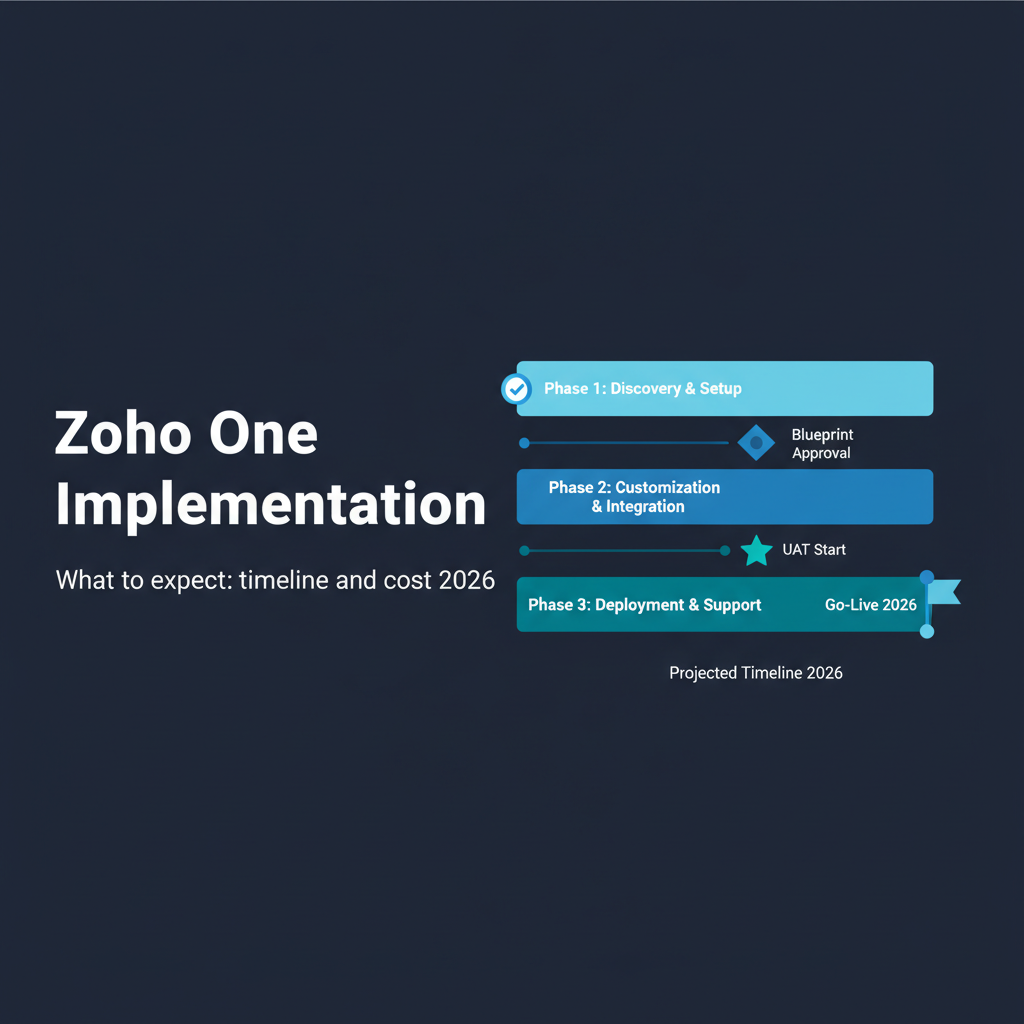
If you’re evaluating Zoho One for your business, one of the first questions you’ll ask is: what does a proper implementation look like, and what will it cost? The internet is full of vague answers. This guide gives you specific timelines, realistic cost ranges, and an honest breakdown of what you’re paying for — based on real implementations for Canadian SMEs.
What a Zoho One Implementation Actually Includes
Zoho One is a suite of 45+ apps. An “implementation” doesn’t mean configuring all 45 — it means configuring the subset of apps your business will actually use, connecting them to your existing tools, migrating your data, setting up automations, and training your team.
For most Canadian SMEs, a core Zoho One implementation covers:
- Zoho CRM: Module setup, custom fields, pipeline configuration, basic automations, and Shopify or other data source integration
- Zoho Desk: Channel setup (email, chat), routing rules, SLA policies, basic automations, and CRM integration
- Zoho Analytics: Data source connections (Shopify, CRM, Desk), dashboard builds for executive and operational views
- Zoho Books or Zoho Inventory: If replacing existing accounting or inventory software — data migration and configuration
- Data migration: Importing existing contacts, accounts, deals from your previous CRM or spreadsheets
- Team training: Role-specific training sessions so each team member can perform their core tasks in the new system
Implementation Phases and Timeline
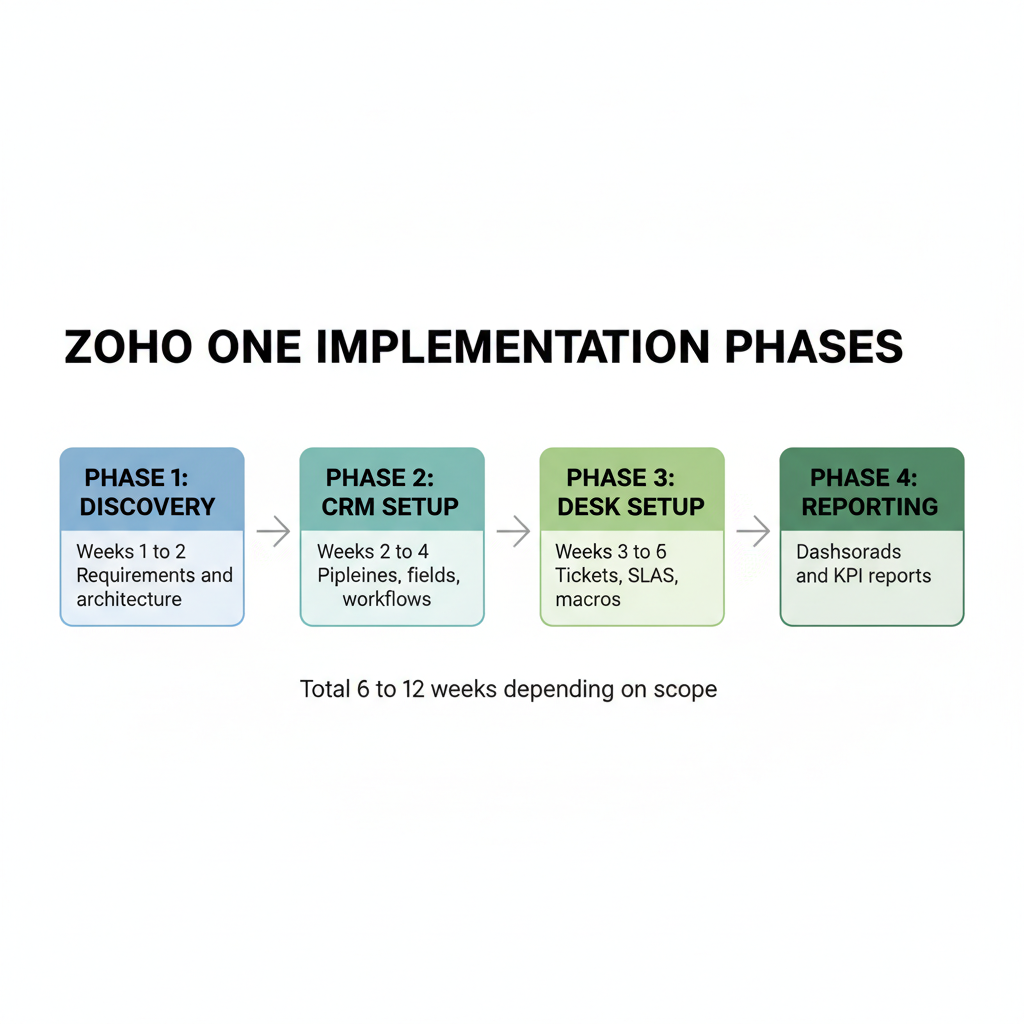
Phase 1: Discovery and Planning (Weeks 1–2)
A consultant works with your team to document your current workflows, define what needs to move to Zoho, map existing data fields to Zoho’s data model, and establish the implementation scope and priority. This phase prevents the most common implementation mistake: configuring Zoho based on assumptions rather than your actual workflows.
Deliverable: Implementation scope document, field mapping guide, integration list, and weekly project plan.
Phase 2: CRM Configuration (Weeks 2–4)
Core CRM setup: module configuration, custom fields, pipeline stages, views, and basic automations. If migrating from HubSpot, Salesforce, or a spreadsheet — data import and de-duplication happens in this phase. Shopify integration is configured and tested.
Deliverable: Working CRM with imported data, live Shopify sync, and five to ten core automations active.
Phase 3: Zoho Desk and Support Setup (Weeks 3–5)
CS helpdesk configured: email and chat channels, routing rules, SLA policies, automations, macros, and knowledge base articles. CRM-Desk integration enabled so tickets show customer order history. CSAT surveys activated.
Deliverable: Fully operational helpdesk receiving and routing tickets from all configured channels.
Phase 4: Analytics and Reporting (Weeks 4–6)
Zoho Analytics data sources connected (Shopify, CRM, Desk, Books/Inventory if applicable). Core dashboard tabs built: executive summary, fulfillment operations, CS performance, and inventory. Scheduled email reports configured. Threshold-based alerts set up.
Deliverable: Live analytics dashboard with automated weekly email report to leadership team.
Phase 5: Training and Handoff (Weeks 5–7)
Role-specific training sessions for each team segment: sales/wholesale team on CRM, CS team on Desk, management on Analytics dashboard. Documentation of key workflows and admin tasks for internal reference. 30-day post-launch support period for questions and minor adjustments.
Deliverable: Trained team actively using the system, admin documentation, and support contact for post-launch questions.
Cost Breakdown
Zoho One License Cost
Zoho One all-employee pricing: approximately $37 USD/user/month billed annually. For a 10-person team: ~$4,440 USD/year, or approximately $6,100 CAD/year at current exchange rates. This is your ongoing annual cost for the software — it includes all 45+ apps with no additional per-module fees.
Implementation Consulting Cost (Canadian SMEs)
Implementation costs depend on scope. Below are realistic ranges for Canadian SMEs:
- Basic implementation (CRM + Shopify integration only, no data migration, no Desk): $3,000–$6,000 CAD
- Standard implementation (CRM + Desk + Analytics, light data migration from spreadsheets): $6,000–$12,000 CAD
- Full implementation (CRM + Desk + Analytics + Books or Inventory, data migration from a previous CRM, custom automations, team training): $12,000–$20,000 CAD
- Enterprise implementation (complex multi-location, multiple integrations, extensive custom workflows, large data migration): $20,000–$40,000 CAD
These ranges assume a qualified Canadian Zoho implementation partner. Offshore consultants may quote lower — but expect longer timelines, language and time zone gaps, and less familiarity with Canadian business context (tax rules, PIPEDA, CAD pricing).
Total First-Year Cost
For a 10-person Canadian SME with a standard implementation:
- Zoho One license (Year 1): ~$6,100 CAD
- Implementation consulting: ~$10,000 CAD
- Total Year 1: ~$16,100 CAD
- Year 2+ (license only): ~$6,100 CAD/year
Compare this to the equivalent Salesforce stack (Sales Cloud + Service Cloud + basic analytics) for 10 users: Year 1 costs typically exceed $40,000–$60,000 CAD when implementation and licensing are combined.
Factors That Affect Cost and Timeline
- Data migration complexity: Migrating from a spreadsheet is simpler than migrating from Salesforce with years of custom fields and complex deal history. Every additional data source adds time and cost.
- Number of integrations: Each external integration (Shopify, 3PL, accounting software) adds scope. A basic Shopify sync takes 1–2 days; a complex multi-channel inventory sync takes a week or more.
- Custom workflows: The more complex your sales or operational processes, the more custom automation configuration is required.
- Team size and training complexity: Larger teams and more diverse roles require more training time.
- Decision-making speed: Implementations that stall during the discovery or feedback phases cost more — time is billed regardless of who causes delay.
DIY vs. Consultant Implementation
A technically capable operations person can implement Zoho One without a consultant. Zoho’s documentation is thorough and the community forum is active. What you’re trading off:
- Time: A DIY implementation typically takes 2–3x longer than a consultant-led one. For a founder or ops manager who already has a full workload, this is often the bigger cost than the consulting fee.
- Quality: First-time implementations often miss edge cases — data de-duplication issues, workflow conflicts, integration failures that only surface at volume. A consultant who has done ten Zoho implementations catches these before they become problems.
- Opportunity cost: The weeks spent learning Zoho’s configuration interface are weeks not spent on the business. A consultant’s value is partly the speed of execution and partly the pattern recognition from prior implementations.
Recommendation: for a basic CRM-only setup with no data migration, DIY is reasonable. For anything involving data migration from a previous CRM, multiple integrations, or a full Zoho One suite deployment, the ROI of a qualified consultant is typically positive within the first six months.
ROI Calculation
How to evaluate whether a Zoho One implementation is worth the cost for your business:
- Current software spend: Add up what you currently pay for CRM, helpdesk, accounting, email marketing, analytics, and inventory tools separately. Many SMEs find they’re spending $800–$2,000 CAD/month on tools that Zoho One replaces at $500–$700/month.
- Time savings: Estimate hours per week spent on manual data entry, report generation, and cross-tool reconciliation. At $50–$100/hour equivalent, even 5 hours/week of savings is $13,000–$26,000 CAD/year.
- Revenue impact: Better CRM adoption means fewer deals falling through, more proactive retention, faster follow-up on leads. Conservative estimate: 5–10% improvement in lead conversion and customer retention on a $3M revenue business is $150,000–$300,000 in additional revenue.
A $12,000 CAD implementation investment against $800/month in software savings ($9,600/year) breaks even in 15 months on software cost alone. Add time savings and revenue impact, and most implementations break even in 6–9 months.
What to Expect Week by Week
Setting expectations is as important as the implementation itself. Here is what a typical 6-week standard implementation looks like from the client side:
- Weeks 1–2: Lots of questions from the consultant. You’ll be reviewing your current workflows, exporting data from old systems, and approving the implementation scope. This feels slow but is foundational.
- Weeks 3–4: A working CRM starts to appear. You’ll be reviewing configuration and providing feedback. Expect two to three rounds of adjustment on field naming, pipeline stages, and views.
- Week 5: Integrations go live. Shopify starts syncing. A first test of the helpdesk routing. You’ll notice things that need adjustment — this is normal and expected.
- Week 6: Training. Your team encounters the system for the first time in a hands-on context. There will be questions and initial friction — this is the adoption hump, not a sign of a bad implementation.
- Weeks 7–10: Post-launch support. The team is using the system daily, discovering edge cases, and requesting refinements. A good implementation partner is available to handle these quickly.
Interested in a Zoho One implementation for your Canadian business? Learn about our Zoho One implementation service or book a free discovery call to discuss your specific scope and timeline.
Frequently Asked Questions
How long does a Zoho One implementation take?
A standard implementation for a Canadian SME (CRM + Desk + Analytics, light data migration) takes 5–7 weeks with a consultant. A full implementation including data migration from a previous CRM and Books or Inventory setup takes 8–12 weeks. Complex multi-location or multi-integration implementations may run 12–16 weeks.
How much does Zoho One implementation cost in Canada?
Implementation consulting typically ranges from $6,000 to $20,000 CAD for a standard SME implementation, depending on scope. Add the Zoho One license (~$6,100 CAD/year for 10 users at all-employee pricing). Total first-year investment typically ranges from $12,000 to $26,000 CAD.
What’s included in the Zoho One license?
Zoho One includes access to 45+ Zoho applications: CRM, Desk (helpdesk), Books (accounting), Inventory, Analytics, Campaigns (email marketing), Projects, Forms, Cliq (team messaging), Creator (custom app builder), and more. All applications share a common data layer — customer records, contacts, and transactions are accessible across all apps without additional syncing.
Can I phase the implementation to manage cost?
Yes, and it’s often the recommended approach. Start with CRM and Shopify integration in Phase 1 (4 weeks, lower cost). Add Desk and Analytics in Phase 2 (4 weeks). Add Books or Inventory in Phase 3 if needed. A phased approach distributes cost, allows the team to adopt one system at a time, and reduces implementation risk.
Is Zoho One support available in Canada?
Zoho provides global support via email, phone, and chat. Canadian implementation partners provide local support with Canadian business context, time zone alignment, and familiarity with Canadian tax rules and compliance requirements. For SMEs, a Canadian implementation partner is typically more effective for ongoing support than Zoho’s global support channels.
Keep reading
- Zoho CRM vs. Zoho One: Which Do You Actually Need? (2026)
- Zoho One for E-commerce: Is the Full Suite Worth It?
- Zoho One Review 2026: Is It Worth It for E-commerce?
- Zoho One vs. Individual Zoho Apps: Which Makes Sense for a Growing Business?
Need hands-on help? Explore our Zoho Implementation →
