If you run an e-commerce business and you’re evaluating Zoho One, you’ve probably seen the pitch: 45+ integrated apps, one price, built for growing businesses. But does it actually hold up for an e-commerce operation? After working with multiple Canadian product brands through Zoho One implementations, here is an honest, detailed review for 2026.
The short answer: yes, Zoho One is worth it for e-commerce — with caveats. It’s not a plug-and-play solution. It requires implementation investment to configure correctly for an e-commerce context. But when done right, it replaces three to six separate software tools and gives you a unified view of your business that standalone tools can’t provide.
What Is Zoho One?
Zoho One is a bundled subscription that gives you access to over 45 Zoho business applications under one license. Think of it as the operating system for a growing business — it covers the core functions that every business needs to run: customer relationship management, customer support, accounting, inventory, email marketing, analytics, project management, and HR.
The key differentiator from buying individual tools is that all Zoho apps share a common data layer. A customer record in Zoho CRM is the same record as in Zoho Desk (support), Zoho Campaigns (email), and Zoho Analytics (reporting). No syncing, no duplicate records, no data reconciliation between platforms. For an e-commerce business trying to understand the full customer journey — acquisition, purchase, support, retention — this unified data model is genuinely valuable.
Pricing in 2026
Zoho One has two pricing options:
- All Employee Pricing: ~$37 USD/user/month (requires all employees to be on the plan). This is the best value if you’re licensing the whole team.
- Flexible User Pricing: ~$90 USD/user/month (license only the users who need access). Better for small businesses where only a few people use the software tools.
For context: if you currently pay for Shopify + a separate CRM + a helpdesk tool + an email marketing platform + accounting software + an analytics tool, you’re likely spending $500–$1,500/month on software before you consider the Zoho apps that replace them. A 5-person e-commerce team on Zoho One at flexible pricing pays $450 USD/month — and gets accounting, CRM, helpdesk, inventory, analytics, and email marketing included.
Note: Zoho One doesn’t replace Shopify — it complements it. Shopify remains your storefront and order management system. Zoho One handles everything around it: CRM, support, analytics, and inventory management.
Key Apps for E-commerce
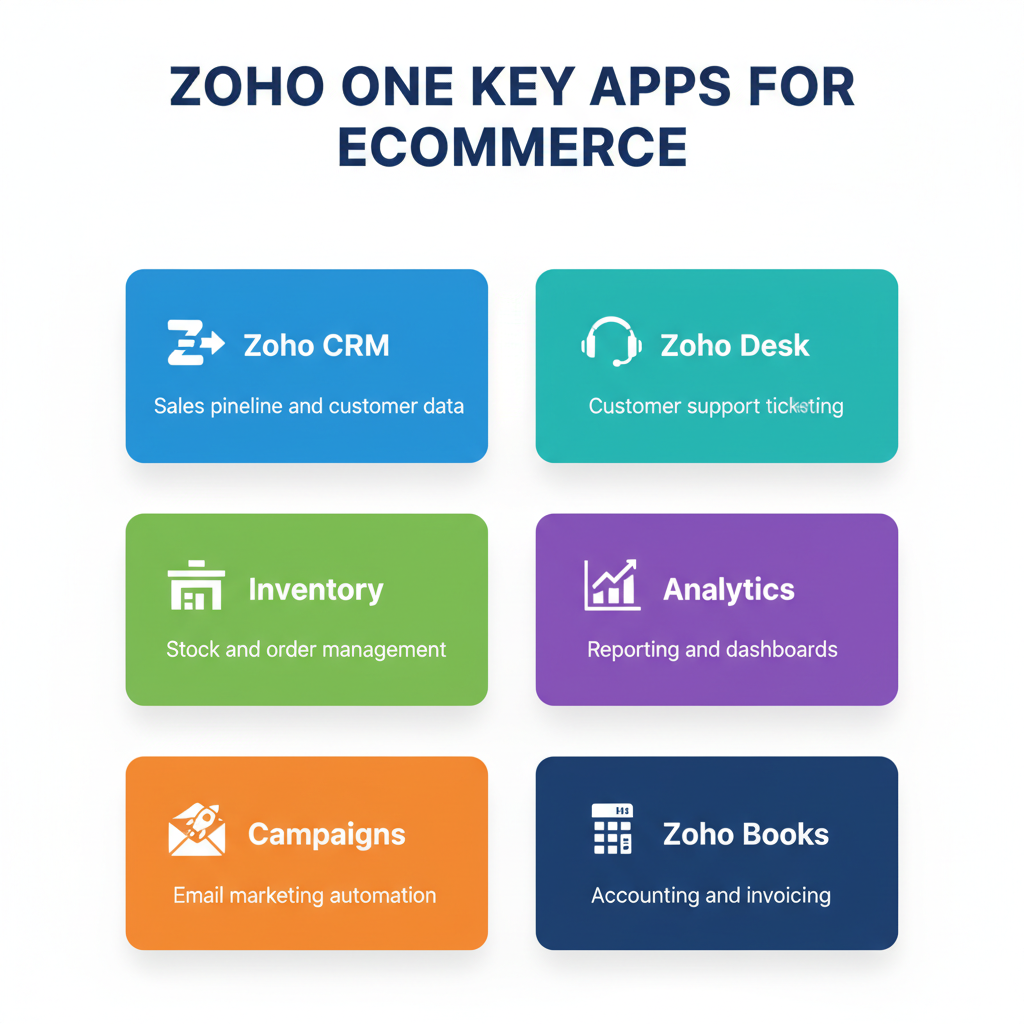
Zoho CRM
The anchor app. For e-commerce, CRM is most valuable for managing wholesale accounts, high-value DTC customers (VIP segment), and any B2B or retail relationships. Connect it to Shopify to sync customer data and order history. Use it to track retention signals, segment customers by LTV, and manage reorder pipelines for wholesale accounts.
Zoho Desk
Customer support ticketing with email, chat, and phone integration. For a Shopify brand handling 50–500 support tickets per week, Zoho Desk handles routing, SLAs, canned responses, and escalation without the complexity of enterprise helpdesk platforms. The integration with Zoho CRM means every ticket automatically appears in the customer’s CRM record — your CS team and sales team see the same customer history.
Zoho Inventory
Multi-channel inventory management that connects to Shopify, Amazon, eBay, and other storefronts. For brands managing inventory across multiple channels, Zoho Inventory can serve as the central inventory system — updating stock levels across all channels from one place. It also handles purchase orders, vendor management, and basic warehouse operations.
Zoho Books
Accounting software for Canadian businesses, including GST/HST support, multi-currency, and bank reconciliation. If you currently use QuickBooks or FreshBooks, Zoho Books is a direct replacement that integrates natively with all other Zoho apps — so invoices, payments, and customer data are connected without manual export/import.
Zoho Analytics
A full business intelligence tool. Connect it to your Shopify store, Zoho CRM, Zoho Desk, and Zoho Books to build dashboards that answer real business questions: revenue by channel, customer LTV distribution, support ticket volume by type, inventory turnover by SKU. For brands coming from Google Sheets–based reporting, Zoho Analytics is a step-change in visibility.
Zoho Campaigns
Email marketing platform with automation, segmentation, and A/B testing. Contact data syncs from Zoho CRM, so your email segments reflect your CRM segments (VIP, At-Risk, Last Purchase Date). For brands using Klaviyo: Zoho Campaigns is less purpose-built for e-commerce email than Klaviyo but covers the core use cases. Brands paying $300–$800/month for Klaviyo may find Zoho Campaigns sufficient and prefer the consolidated billing.
Shopify Integration
The Shopify-to-Zoho integration is critical and achievable. Here is what you can sync:
- Shopify customers → Zoho CRM Contacts (bidirectional sync available)
- Shopify orders → Zoho Inventory orders and Zoho CRM activities
- Shopify products → Zoho Inventory product catalog
- Shopify order tags → Zoho CRM custom fields (useful for VIP flagging)
The native connector is Zoho Flow. For more complex sync requirements — full order history, variant-level data, refunds — a custom Zoho Flow workflow or a third-party integration (Zapier, Make) can extend coverage. Most e-commerce brands need 3–5 Zoho Flow workflows to cover the core integration points.
Pros of Zoho One for E-commerce
- Consolidated stack: One vendor, one billing relationship, one data layer. Reduces software sprawl significantly for brands currently using 5–8 separate tools.
- Unified customer view: Support history, order history, marketing engagement, and pipeline notes all in one record. Reduces the “I don’t know what the customer’s experience has been” problem that costs brands retention.
- Canadian compliance: Zoho Books handles Canadian tax (GST/HST), Zoho operates Canadian data centres, and pricing is available in CAD. This matters for PIPEDA compliance and accounting accuracy.
- Scalable pricing: The per-user cost doesn’t spike dramatically as you add people. Moving from 5 to 10 users doubles the cost — unlike some platforms that have steep jumps at usage tiers.
- No-code automation: Zoho Flow and Zoho CRM’s workflow automation handle the majority of cross-app automations without developer involvement.
Cons and Limitations
- Implementation required: Zoho One out of the box is not set up for e-commerce. You need to configure the CRM pipeline, custom fields, Shopify integration, and automations. Plan for 4–8 weeks of setup with a consultant, or 8–12 weeks DIY.
- App quality varies: The 45+ apps in Zoho One are not all equal. CRM, Desk, Analytics, and Books are mature and capable. Some lesser-used Zoho apps are thinner. For the core e-commerce use cases, the quality is sufficient.
- Klaviyo/Drip replacement is imperfect: Zoho Campaigns is a solid email platform but doesn’t have the same depth of e-commerce-specific features (browse abandonment, predictive sending, Shopify revenue attribution per email) that Klaviyo has. Brands with sophisticated email programs may keep Klaviyo alongside Zoho One.
- 3PL integration: Zoho Inventory is designed for businesses managing their own warehouse. For brands using a 3PL like Extensiv, the WMS integration is with Extensiv’s system — Zoho Inventory becomes less central. Clarify your fulfillment model before deciding how to use Zoho Inventory.
- Learning curve: 45 apps is a lot. New users benefit from a phased approach — start with CRM, Desk, and Analytics, then expand. Trying to deploy everything at once overwhelms teams and leads to low adoption.
Real-World E-commerce Use Cases
Canadian wellness brand, $3M revenue, Shopify + 3PL: Previously using Salesforce (too expensive), Zendesk (separate helpdesk), and QuickBooks (separate accounting). Moved to Zoho One: CRM for wholesale account management, Desk for CS, Books for accounting. Saved ~$1,200 CAD/month in software costs. Support ticket resolution time dropped 30% due to CRM-linked ticket history.
Ontario food brand, $7M revenue, DTC + retail: Managing both Shopify DTC orders and retail wholesale accounts from one Zoho CRM instance. Zoho Analytics dashboard pulls Shopify revenue + retail account data + CS ticket volume into one weekly ops view. Team of 12 reduced weekly reporting prep from 4 hours to 30 minutes.
Verdict: Is Zoho One Worth It for E-commerce?
Yes — for the right business profile. Zoho One delivers maximum value for e-commerce brands that:
- Are in the $1M–$20M revenue range
- Currently use 4+ separate software tools with no integration
- Have a mix of DTC and wholesale channels to manage
- Want unified reporting across sales, support, and operations
- Are willing to invest in a proper implementation (not just turn it on and hope)
If you’re a single-channel DTC brand with no wholesale component, Shopify alone may be sufficient and Zoho One may be over-engineered. If you’re managing multiple channels, a retail or wholesale relationship, and a CS team, Zoho One will pay for itself within the first year through reduced software costs and time savings from unified data.
Considering Zoho One for your e-commerce business? Learn about our Zoho One implementation service or book a free discovery call.
Frequently Asked Questions
Does Zoho One replace Shopify?
No. Zoho One complements Shopify — it doesn’t replace it. Shopify remains your storefront and order management system. Zoho One handles everything around it: CRM, customer support, analytics, inventory management, and accounting. The two platforms integrate via Zoho Flow.
How much does Zoho One cost for a 5-person team in Canada?
At flexible user pricing (~$90 USD/user/month), a 5-person team pays approximately $450 USD/month, or roughly $620 CAD/month at current exchange rates. This covers all 45+ Zoho apps. If all employees use the platform, the all-employee pricing (~$37 USD/user/month) reduces cost to ~$185 USD/month for 5 users.
Is Zoho One hard to set up?
It requires real configuration. A default Zoho One install is not set up for e-commerce — you need to configure CRM pipelines, custom fields, Shopify integration, and automations. With a consultant, plan for 4–8 weeks. DIY takes 8–12 weeks. The investment is one-time; the payoff is ongoing.
Can Zoho One replace Klaviyo for email marketing?
Partially. Zoho Campaigns handles standard email marketing — newsletters, drip sequences, segmentation, and A/B testing. What it doesn’t match is Klaviyo’s e-commerce-specific features like browse abandonment, deep Shopify revenue attribution, and predictive LTV analytics. Brands with sophisticated email programs often keep Klaviyo; brands with simpler needs find Zoho Campaigns sufficient.
What’s the ROI of Zoho One for e-commerce?
ROI comes from three areas: software cost consolidation (typically $400–$1,200 CAD/month saved vs. separate tools), time savings from unified data (no manual exports between systems), and revenue impact from better customer visibility (improved retention, faster CS resolution). Most brands see positive ROI within 6–12 months of a proper implementation.
Keep reading
- Zoho One for E-commerce: Is the Full Suite Worth It?
- Zoho CRM vs. Zoho One: Which Do You Actually Need? (2026)
- Zoho Inventory for E-commerce: Features, Setup, and When to Use It
- Zoho One Implementation: What to Expect (Timeline + Cost) 2026
Need hands-on help? Explore our Zoho Implementation →
