Salesforce is the world’s most recognized CRM. Zoho One is the underdog that quietly outpaces it for a specific type of business. If you run a Canadian small or mid-sized business evaluating CRM platforms, this comparison is designed to give you an honest read — not a marketing pitch.
The short version: Salesforce is built for enterprise sales teams with large budgets and dedicated admins. Zoho One is built for growing businesses that need a full software suite — CRM, helpdesk, finance, inventory, analytics — without the cost and complexity of an enterprise platform. For most Canadian product brands in the $1M–$20M range, Zoho One wins on almost every relevant dimension.
Platform Overview
Salesforce
Salesforce launched in 1999 and became the gold standard for enterprise CRM. Its core product — Sales Cloud — is a powerful pipeline management tool used by Fortune 500 companies worldwide. Salesforce also offers Service Cloud (helpdesk), Marketing Cloud (email/automation), Commerce Cloud, and a growing ecosystem of add-ons.
The platform is deep. It can be customized for nearly any use case. It has the largest CRM ecosystem, the most third-party integrations, and an enormous professional services and consulting network. But that depth comes with cost, complexity, and a need for ongoing administration that most small businesses aren’t staffed to handle.
Zoho One
Zoho One, launched in 2017, is a bundled suite of over 45 business applications. Rather than buying Salesforce + a helpdesk tool + an accounting system + an analytics platform + a project management tool separately, Zoho One provides all of them under one license.
The anchor app is Zoho CRM, which handles sales pipeline management. Alongside it: Zoho Desk (helpdesk), Zoho Books (accounting), Zoho Inventory, Zoho Analytics, Zoho Campaigns (email), Zoho Projects, Zoho Forms, and more. The applications share a common data model, so a customer record in CRM is the same record in Desk and in Analytics — no syncing required.
Pricing Comparison
This is where the gap becomes stark.
Salesforce Sales Cloud:
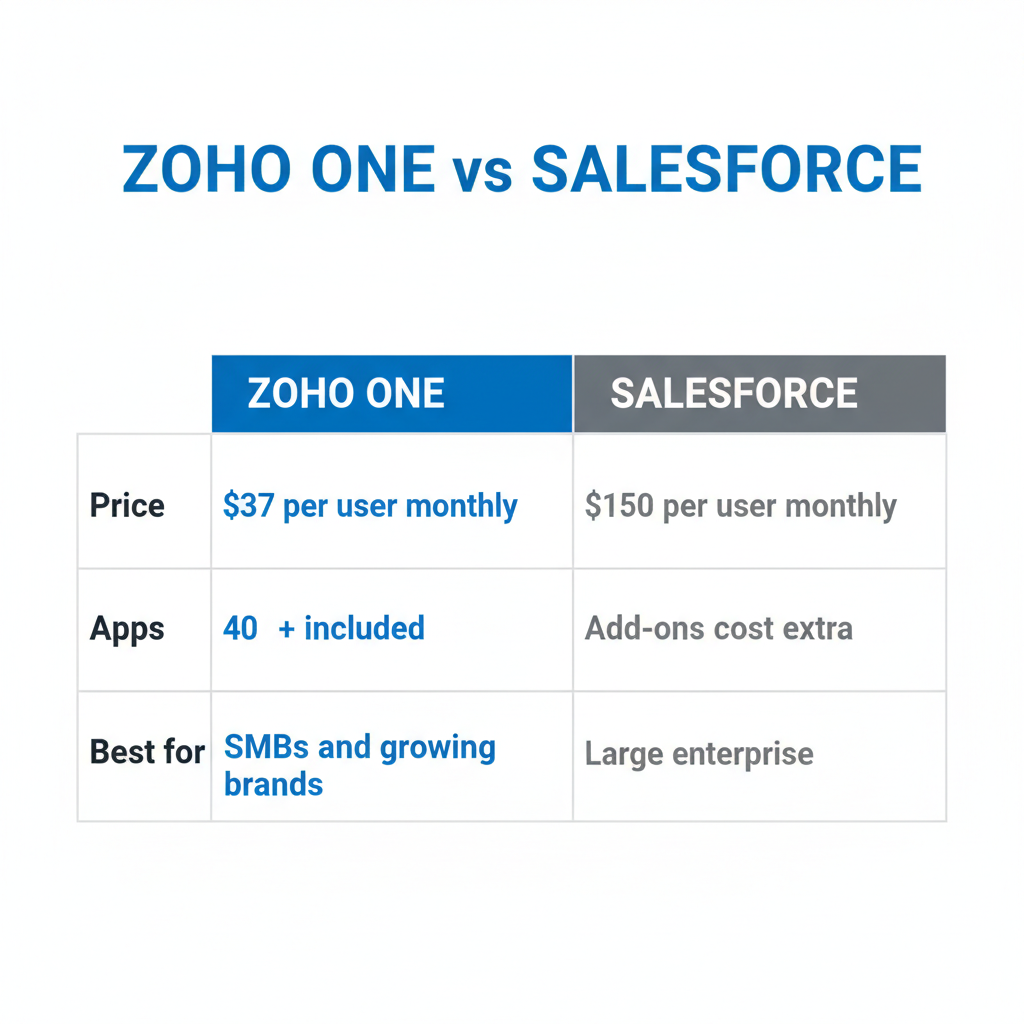
- Starter Suite: ~$35 USD/user/month (limited features)
- Professional: ~$80 USD/user/month
- Enterprise: ~$175 USD/user/month
- Unlimited: ~$350 USD/user/month
These prices are for Sales Cloud only. If you need a helpdesk, that’s Service Cloud — a separate license. If you need email marketing, Marketing Cloud is another separate license. A fully integrated Salesforce stack for a 10-person team can easily run $2,000–$5,000+ USD/month before implementation costs.
Zoho One:
- All Employee Pricing: ~$37 USD/user/month (billed annually, covers ALL apps)
- Flexible User Pricing: ~$90 USD/user/month
For a 10-person team, Zoho One at the all-employee rate is approximately $370 USD/month for everything: CRM, helpdesk, accounting, inventory, analytics, email marketing, projects, and 40+ more apps. That’s often less than a single Salesforce license for one user at the Professional tier.
For Canadian businesses, this price differential is amplified by the CAD/USD exchange rate. Salesforce’s enterprise tier pricing in Canadian dollars can reach $200–$450/user/month, making it cost-prohibitive for most SMEs without a dedicated budget for software infrastructure.
Feature Comparison
Sales Pipeline Management
Both platforms handle core pipeline management well: deals, contacts, accounts, activities, stages, and forecasting. Salesforce’s pipeline views are highly configurable. Zoho CRM’s pipeline is more intuitive out of the box for small teams and covers the same core functionality at lower tiers.
Edge: Salesforce for complex enterprise sales with multiple teams, territories, and approval chains. Edge: Zoho CRM for SMEs needing quick deployment without a dedicated admin.
Automation
Salesforce’s Flow Builder is one of the most powerful automation tools in any CRM — capable of complex multi-step workflows, approval processes, and field updates. But building non-trivial automation in Salesforce typically requires Salesforce-certified expertise or a consulting engagement.
Zoho CRM’s workflow automation is strong and accessible to non-developers. Combined with Zoho Flow (their integration platform), you can automate across the full Zoho suite and connect to external apps without writing code. For most SME use cases, Zoho’s automation covers the same territory with significantly less overhead to configure.
Reporting and Analytics
Salesforce Einstein Analytics (now Tableau CRM) is enterprise-grade. It’s also expensive and complex. Most Salesforce SME deployments use basic Salesforce reports, which are functional but not sophisticated.
Zoho Analytics is a dedicated BI tool included in Zoho One. It connects natively to all Zoho apps plus Shopify, Google Analytics, databases, and more. For a product brand wanting a real operations and sales dashboard — inventory, revenue by channel, CS resolution times — Zoho Analytics is the right tool and it requires no extra spend.
Helpdesk
Salesforce Service Cloud is excellent — ticketing, SLAs, knowledge base, omni-channel support. It’s also $80–$175/user/month on top of Sales Cloud. For an SME that wants to run CS through the same platform as CRM, the combined Salesforce cost becomes unrealistic.
Zoho Desk is included in Zoho One. It handles email, chat, phone, and social tickets, has a knowledge base, SLA management, and automation rules. For a growing Shopify brand managing 50–500 CS tickets per week, Zoho Desk is fully capable.
Ease of Use
Salesforce has a steep learning curve. Its terminology (Objects, Fields, Leads vs. Contacts, Opportunities, Flows) is non-intuitive for first-time users. New Salesforce deployments typically require a certified admin or consulting partner to configure correctly. Without one, you end up with a system that’s technically live but unused by the sales team because it’s too complex.
Zoho CRM is faster to onboard. Basic configuration — pipeline stages, contact fields, email integration, basic workflows — can be done by a non-technical ops person in a week. Zoho also offers a guided setup wizard and templates for common business types.
Neither platform is “easy” at enterprise depth. But for an SME that needs to be productive in a CRM within 30 days without hiring a dedicated admin, Zoho is the realistic choice.
Integrations
Salesforce wins on sheer volume of third-party integrations. The AppExchange has thousands of apps. If you’re using enterprise tools — SAP, Oracle, Workday — Salesforce connectors are well-established.
For the typical Canadian product brand stack (Shopify, 3PL like Extensiv, accounting, email marketing), Zoho One has native or low-code connectors for everything you need. Zoho Flow handles cross-app automation. The Zoho-Shopify integration syncs customers, orders, and products. Zoho Inventory handles warehouse data. The ecosystem is complete for this use case without going outside the Zoho suite.
Support and Implementation
Salesforce’s ecosystem has more certified consultants globally. If you’re in a major Canadian city, you can find Salesforce partners. But SME Salesforce implementations routinely cost $15,000–$50,000+ CAD, and ongoing admin support runs $100–$200/hour.
Zoho implementations are less expensive. An SME Zoho One implementation with a qualified consultant typically runs $5,000–$15,000 CAD depending on scope. Ongoing support is available at lower rates. The platform also has strong self-serve documentation and an active community forum.
Canadian Business Context
A few factors make Zoho particularly attractive for Canadian SMEs:
- Exchange rate sensitivity: Salesforce pricing in USD at enterprise tiers is genuinely prohibitive for CAD-revenue businesses with SME margins. Zoho One’s pricing remains manageable in Canadian dollars.
- Canadian data residency: Zoho operates Canadian data centres and offers data residency options for businesses with compliance requirements. This matters for businesses handling personal information under PIPEDA.
- SME fit: Salesforce is optimized for large enterprise sales teams. The features that make it powerful — territory management, complex approval workflows, multi-org architecture — are irrelevant and expensive for a 10-person Canadian brand. Zoho is designed for the business stage where most growing Canadian SMEs actually are.
The Verdict: When to Choose Each
Choose Salesforce if:
- You have a dedicated Salesforce admin on staff or budget for one
- You’re integrating into an enterprise tech stack that already uses Salesforce
- You have complex enterprise sales with multiple teams, territories, and approval workflows
- Budget is not the primary constraint
Choose Zoho One if:
- You’re a Canadian SME in the $1M–$20M revenue range
- You need CRM, helpdesk, inventory, and analytics without buying three separate platforms
- You want to deploy a working system within 4–8 weeks
- You’re running Shopify and want a native integration to Zoho apps
- Budget matters and the CAD/USD exchange rate is a real factor
For the vast majority of Canadian product brands we work with, Zoho One is the right answer. Salesforce is a great platform — for the business stage where its complexity and cost are justified. Most SMEs aren’t there yet, and paying enterprise prices for tools you can’t fully use is one of the fastest ways to kill an ops budget.
Considering Zoho One for your business? Learn about our Zoho CRM Implementation service or book a free discovery call to discuss your specific needs.
Frequently Asked Questions
Is Zoho One really comparable to Salesforce?
For SME use cases, yes. Zoho CRM covers pipeline management, automation, reporting, and integrations at a level that meets or exceeds Salesforce at equivalent price points. Where Salesforce genuinely surpasses Zoho is in enterprise-scale complexity: multi-org setups, deep territory management, and integration with legacy enterprise systems. Most SMEs don’t need those capabilities.
Can I migrate from Salesforce to Zoho CRM?
Yes. Zoho CRM has a built-in Salesforce migration tool that imports contacts, accounts, deals, activities, and custom fields. A qualified implementation partner can typically execute the migration with minimal data loss and set up the equivalent workflows in Zoho within four to eight weeks.
What does Zoho One cost in Canadian dollars?
At the all-employee pricing of approximately $37 USD/user/month, a 10-person team pays roughly $370 USD/month, or approximately $510 CAD/month at current exchange rates. This covers 45+ apps including CRM, helpdesk, accounting, and analytics. Salesforce equivalent coverage would typically cost 5–10x that amount.
Does Zoho One have Canadian data residency?
Yes. Zoho operates data centres in Canada and offers Canadian data residency options. For businesses with compliance requirements under PIPEDA or industry-specific regulations, this is an important advantage over platforms that only offer US-based storage.
How long does a Zoho One implementation take?
A standard Zoho One implementation for a Canadian SME — covering CRM, Desk, and Analytics — typically takes four to eight weeks with a consultant. The timeline depends on data migration complexity, number of integrations (Shopify, accounting software, etc.), and the number of custom workflows needed. A phased approach (CRM first, then add modules) can get you productive in CRM within two to three weeks.
Keep reading
- Zoho CRM vs. Zoho One: Which Do You Actually Need? (2026)
- Zoho One vs. Individual Zoho Apps: Which Makes Sense for a Growing Business?
- Zoho Books vs QuickBooks for Canadian Companies: Complete Comparison and Setup Guide
- How to Set Up Zoho CRM for a Product-Based Business (2026)
Need hands-on help? Explore our Zoho Implementation →
